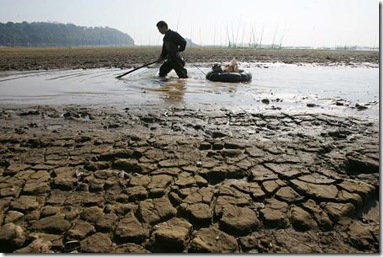
In the
future, in order to maximize the utility of the Three Gorges Dam and cut down
on sedimentation from the Jinsha River, upstream of the Yangtze River before
reaching Yibin in Sichuan, authorities plan to build a series of dams
downstream of Jinsha, including Wudongde Dam, Baihetan Dam, Xiluodu Dam, and
Xiangjiaba Dam. The total capacity of those four dams is 38,500 MW, almost
double the capacity of the Three Gorges. Xiluodu and Xiangjiaba are under
construction, while Baihetan is preparing for construction and Wudongde is
seeking government approval. Another eight dams are in the midstream of the
Jinsha and eight more upstream of it.


 The
Yangtze River (undammed) carries about 680 million tons of silt to the East
China Sea every year, making it one of the most heavily silted rivers in the
world. It is estimated that each year 0.5 billion tons of silt will be trapped
behind the dam, decreasing the effectiveness of the dam to prevent flood
control and increasing the height of riverbeds, and the possibility of
secondary pollution from the release of harmful chemicals that may be carried
with river silt, which is erosion. For the first two decades after TGD
completion, there should be extensive erosion, but the erosion accumulation
should gradually balance out by 2060. However, for the first 50 years after TGD
completion, scholars hypothesize that the Changjiang deltaic area should
undergo significant morphologic and environmental change because of local and
regional erosion. Critics also claim the river won’t flow fast enough to keep
the turbines turning and dam itself will become inoperable after a few years as
a result of silting. (Figure2: Landslide along the river)
The
Yangtze River (undammed) carries about 680 million tons of silt to the East
China Sea every year, making it one of the most heavily silted rivers in the
world. It is estimated that each year 0.5 billion tons of silt will be trapped
behind the dam, decreasing the effectiveness of the dam to prevent flood
control and increasing the height of riverbeds, and the possibility of
secondary pollution from the release of harmful chemicals that may be carried
with river silt, which is erosion. For the first two decades after TGD
completion, there should be extensive erosion, but the erosion accumulation
should gradually balance out by 2060. However, for the first 50 years after TGD
completion, scholars hypothesize that the Changjiang deltaic area should
undergo significant morphologic and environmental change because of local and
regional erosion. Critics also claim the river won’t flow fast enough to keep
the turbines turning and dam itself will become inoperable after a few years as
a result of silting. (Figure2: Landslide along the river)Also, based on the current design, the TGD project cannot provide enough water from the Yangtze River for Beijing. For Beijing to make use of the reservoir water, it would be necessary to raise the height of the dam, rebuild pump stations, or dig a new canal. This would cost as much as constructing another Three Georges dam.

According
to the data given, it is obvious that a larger scheme would contain a larger
active storage for more reserve volume to generate greater hydroelectric power.
However, due to the greater storage volume, there will be a greater chance for
a large reservoir to be produced. Reservoir areas are well known for
landslides. The erosion of the reservoir banks may trigger large-scale
landslides.
Reference:
"Giant Chinese Dam May Cause Earth to Move, Alaska Science Forum." Giant Chinese Dam May Cause Earth to Move, Alaska Science Forum. <http://www2.gi.alaska.edu/ScienceForum/ASF14/1465.html>.
Lim, Theodore. "All About the Three Gorges Dam." Sherwood Institute All About the Three Gorges Dam Comments.
<http://www.sherwoodinstitute.org/all-about-the-three-gorges-dam/>.
Min, Kris. "Three Gorges, Infinite Reasons." <http://darwin.bio.uci.edu/%7Esustain/state/kmin.html.>